When Christians Find it Hard to Resist Sinning
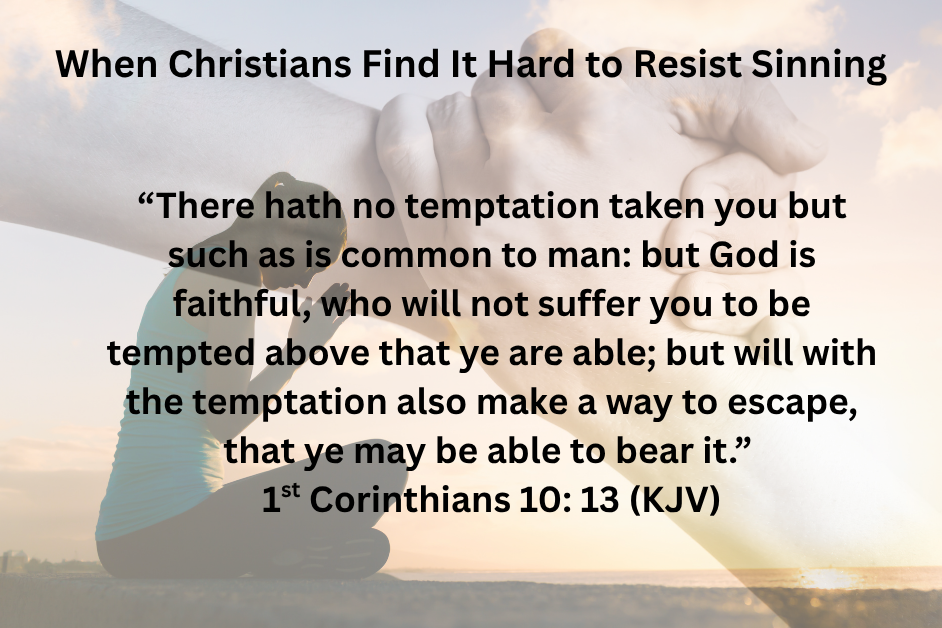
When Christians Find It Hard to Resist Sinning
There have been times when some Christians have found it hard to resist the “bad things” of life (such as sin or worldly temptations) because of an ongoing internal struggle between their spiritual desires and their human nature. This tension creates a very real, day-to-day challenge that requires constant vigilance.
21 For I know that in me (that is, in my flesh,) dwelleth no good thing: for to will is present with me; but how to perform that which is good I find not. 19For the good that I would I do not: but the evil which I would not, that I do. 20Now if I do that, I would not, it is no more I that do it, but sin that dwelleth in me.
21I find then a law, that, when I would do good, evil is present with me. 22For I delight in the law of God after the inward man: 23But I see another law in my members, warring against the law of my mind, and bringing me into captivity to the law of sin which is in my members. 24O wretched man that I am! Who shall deliver me from the body of this death? Romans 7: 18-24 (KJV)
The reasons for this difficulty are multifaceted and central to the Christian experience. When Christians find it hard to resist sin, it is time for a re-evaluation of where they stand with God.
The Reasons And Descriptions Thereof
- The Human Nature (“The Flesh”)
-
- Inherent Desires: Christians believe that while their spirit is renewed upon accepting faith, they still possess a human nature, often referred to in the Bible as “the flesh.” This aspect of humanity naturally gravitates toward comfort, self-preservation, and immediate gratification.
- Habitual Conditioning: It takes time to break old, ingrained behavioral patterns, making the pull of familiar, yet destructive, habits difficult to overcome instantly.
- Spiritual Temptation
-
- External Influences: Christians believe in an active spiritual adversary (often called Satan) and the influence of a “fallen world,” both of which actively seek to distract individuals from their faith or lead them into destructive behaviors.
- The Allure of Sin: Temptations are often difficult to resist because they offer immediate, tangible pleasures, whereas the rewards of obedience and righteousness require patience and long-term faith.
- Misplaced Self-Reliance
-
- Willpower vs. Grace: Many believers struggle because they try to resist temptation using their own sheer willpower rather than relying on spiritual strength.
- The Need for Community: The Christian faith emphasizes the importance of accountability and community support. When isolated from other believers, individuals often find it much harder to overcome their struggles.
- A Process of Spiritual Growth
-
- Sanctification: In Christian theology, overcoming sin is described as sanctification—a lifelong, gradual process of transformation rather than an instant magical fix. The struggles encountered are often viewed as necessary tests that ultimately build endurance, humility, and deeper reliance on God.
- Continuous Learning: Falling short does not necessarily indicate a failure of faith, but rather serves as a reminder of the need for continuous grace, forgiveness, and spiritual renewal.
One Resolution for When Christians Find It Hard to Resist Sinning – Short and sweet:
“Submit yourselves therefore to God. Resist the devil, and he will flee from you.” 8Draw nigh to God, and he will draw nigh to you. Cleanse your hands, ye sinners; and purify your hearts, ye double minded. 9Be afflicted, and mourn, and weep: let your laughter be turned to mourning, and your joy to heaviness. 10Humble yourselves in the sight of the Lord, and he shall lift you up. James 4: 7-10 (KJV)
How to Press Forward Instead of Backward When Tempted
Resisting sin is not only about saying “no” in the moment; it is also about learning how to turn your heart, mind, and habits toward what is good before temptation gains strength.
Moving forward means choosing obedience one step at a time, even when emotions, memories, or desires pull in the opposite direction. Progress is often built through small, repeated decisions that keep a believer close to God rather than drifting toward what weakens the soul.
-
- Recognize temptation early: Many spiritual defeats happen long before the visible act. They begin in thought patterns, unchecked desires, loneliness, pride, frustration, or secrecy. Learning to identify the beginning of temptation helps a person respond before it becomes stronger.
- Replace, do not merely remove: It is often not enough to stop a sinful action; there must also be a deliberate replacement with what is true, pure, and life-giving. Prayer, Scripture, worship, honest conversation, productive work, and wise routines help fill the space that temptation tries to occupy.
- Cut off what feeds weakness: Pressing forward sometimes requires serious honesty about environments, entertainment, relationships, habits, and private compromises that continually pull the heart backward. Spiritual growth often involves removing access to what repeatedly leads to stumbling.
- Depend on God in the moment: Temptation often feels strongest when a person believes they must overcome it alone. Turning immediately to God in prayer, even with a simple cry for help, shifts the struggle from self-reliance to dependence on divine strength.
- Stay accountable: Sin grows in isolation, but strength often grows in the light. Trusted Christian community, wise counsel, and honest accountability can interrupt cycles of compromise and help restore direction when someone begins to drift.
- Do not let failure become surrender: If a person stumbles, the danger is not only the sin itself but the hopelessness that can follow it. Pressing forward means repenting quickly, receiving grace, learning from one’s mistakes, and refusing to believe that a single failure must become a pattern.
A forward-moving life is sustained by remembering that temptation promises relief, pleasure, control, or escape, but rarely tells the truth about its cost. Sin often weakens peace, clouds judgment, damages trust, and creates distance in the inner life.
By contrast, pressing forward in obedience may require sacrifice in the present, but it strengthens character, deepens fellowship with God, and produces long-term freedom. In this way, each resisted temptation becomes more than a private victory; it becomes a step in spiritual maturity.
It is also important to understand that pressing forward does not always feel dramatic. Sometimes it looks like leaving a situation early, changing a routine, confessing a struggle, turning off something unhelpful, or choosing silence and prayer instead of feeding harmful thoughts. These quiet acts of obedience matter.
They train the heart to choose what leads to life, and over time, they help form new patterns that honor God.
In Summary: When Christians find it Hard to Resist Sinning
Pressing forward requires vigilance, humility, replacement of unhealthy patterns, dependence on God, and perseverance after setbacks.
The Christian life is not a call to pretend the battle is easy, but a call to keep walking in truth, even when the battle is real. Victory often comes not from one dramatic moment, but from repeatedly choosing the next right step.
Christian Self-Awareness: Examining Ourselves