To Everything There is a Season- Solomon’s Writing in Ecclesiastes
To Everything There is a Season-Solomon’s Writing in Ecclesiastes and What This Inspiration Confirms
When life things hit hard, unannounced, unwarranted, and without hope of a positive outcome, it is then that most people recall the scripture in Ecclesiastes 3: 1-8. This scripture gives the expectation of what life is all about. It gives a warning that every day may not be as we think it should be, or as we want it to be.
Let’s break this down to our understanding and how to cope when the seasons seem to be out of human control.
“To every thing there is a season, and a time to every purpose under the heaven: 2A time to be born, and a time to die; a time to plant, and a time to pluck up that which is planted; 3A time to kill, and a time to heal; a time to break down, and a time to build up; 4A time to weep, and a time to laugh; a time to mourn, and a time to dance; 5A time to cast away stones, and a time to gather stones together; a time to embrace, and a time to refrain from embracing; 6A time to get, and a time to lose; a time to keep, and a time to cast away; 7A time to rend, and a time to sew; a time to keep silence, and a time to speak; 8A time to love, and a time to hate; a time of war, and a time of peace.”
Solomon’s Purpose WasTo Reveal Meaningful Living
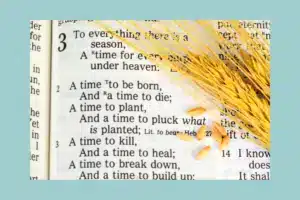 Solomon wrote Ecclesiastes to demonstrate that a life focused solely on worldly pursuits, pleasure, wealth, and wisdom is meaningless (“vanity”) and empty without God. As a seasoned reflection on his own life, the book serves as a warning and guide, advising that true meaning, purpose, and contentment are only found in fearing God and keeping His commandments.
Key Purpose of the Book Includes: Exposing the Futility of Life “Under the Sun”: Solomon argues that everything in the physical world is temporary, ultimately unsatisfying, and a “chasing after the wind”.
Contrasting Wisdom and Folly: He shows that while wisdom is better than folly, both the wise and the foolish face the same ultimate fate of death, making earthly achievements ultimately meaningless.
Encouraging Enjoyment of Simple Pleasures: Amidst the emptiness, Solomon encourages finding satisfaction in daily life, eating, drinking, and working as gifts from God.
A Final Call to Godliness: The ultimate conclusion is that because life is short and complex, a person’s duty is to fear God, who will judge all things.
What Solomon Emphasized When He Wrote This Passage
Solomon wasn’t simply listing opposites. He was revealing a deep truth about life under God’s sovereignty:
Life comes in seasons because God works through timing, not sameness, and Solomon had lived long enough and seen enough to understand that:
- Life is not steady.
- Life is not predictable.
- Life is not one‑dimensional.
- Life is not controlled by human desire.
Instead, life unfolds in God‑appointed rhythms. Some seasons feel like a gain, others feel like a loss. Some bring joy, others bring breaking. Some bring clarity, others bring silence.
When the heart feels as if it will never recover from a loss, God knows what might have happened if there had been no loss. This is often His protection from something much, much worse.
Life Comes in Different Forms Because God Uses
“Life comes in different forms because God uses different seasons to grow different aspects of our lives.”
-
- In planting seasons, He grows patience.
- In uprooting seasons, He removes what can’t stay.
- In weeping seasons, He deepens compassion.
- In laughing seasons, He restores joy.
- In breaking‑down seasons, He clears what’s in the way.
- In building‑up seasons, He strengthens what’s meant to last.
- In silent seasons, He teaches us to listen.
- In speaking seasons, He gives us courage.
Every season forms something in us that another season cannot. This is why life comes in different forms: because God is doing a different work in each one, and He will give you what you need to bear whatever comes.
One of Solomon’s points is not that life is all about chaos, but that life can change. Often for the benefit of a purpose. The seasons we love and the seasons we dread, or those that come without a moment’s notice, are both part of God’s plan.
Life shifts because God is always moving us toward maturity, trust, and deeper dependence on Him. What feels out of control to us is never out of control to Him.
So, How Should a Human React When The Season Seems Out of Control?
- Accept Impermanence (Stop the Struggle): Acknowledge that you cannot control the start or end of seasons, as life is intentionally designed with changing times—some good, some difficult.
- Trust in Divine Timing: Understand that God has established a time for everything, and He holds all things in control even when it feels chaotic.
- Embrace the Current Season: Do not waste energy trying to force one season to last forever (e.g., trying to have summer in winter). Instead, find the purpose in the present, whether it is a time to work, rest, weep, or laugh.
- Find Joy and Act Now: Since you cannot control the future, focus on enjoying the simple, daily blessings of life (eating, drinking, and finding satisfaction in your work) as a gift from God.
- Keep Working and Giving: Do not fall into passive despair. The book encourages action—investing, giving, and living faithfully—even when the outcome is uncertain, as discussed in Ecclesiastes 11.
Summary
To Everything There is a Season